


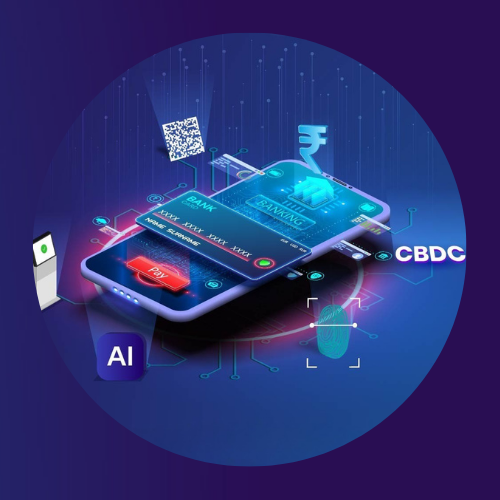
The last decade saw India’s payments revolution go stratospheric: deeper adoption of UPI continued to spark a surge in cashless payments in 2025. Today India has over 10,000 fintech firms (the third-largest in the world) and a deep digital infrastructure of Aadhaar, UPI and mobile internet. By December 2025, India’s UPI handled about 21.6 billion transactions (value of ₹27.96 lakh crore), underscoring how embedded digital payments are.
Looking to 2026, five trends will supercharge this momentum and bridge the inclusion gap, bringing services to rural and differently-abled users. Each trend promises new convenience and access.
Trend 1: AI and Automation Everywhere
Artificial intelligence and automation will be embedded across banking and fintech operations.
By 2026, institutions will increasingly use AI tools to underwrite loans, detect fraud in real time, streamline the KYC process, and deliver personalized services.
AI can scan mountains of data in milliseconds — spotting anomalies or identifying creditworthy customers. Routine tasks like loan approvals and account openings will be driven by automated workflows, improving speed, consistency, and cost efficiency. AI-powered conversational assistants in multiple Indian languages (chatbots, voicebots) provide 24/7 support, lowering service costs while improving the customer experience.
According to industry surveys, over 60% of APAC financial firms are prioritizing AI-led automation by 2026, making AI a major catalyst across servicing, collections, underwriting support, and KYC/fraud prevention. AI-driven personalization will tailor offers, credit limits, and insights to each user’s behaviour, helping fintechs engage customers better, manage risk smarter, and profitably serve underserved segments at scale.
Trend 2: Biometric, Face & Palm Payments Take Off
Face, fingerprint, and even palm are becoming mainstream payment keys.
Regulators and industry are moving beyond PINs: starting Oct 2025, the RBI and NPCI permit Aadhaar-based fingerprint or facial recognition for UPI transactions, so customers can “show a smile” or touch a scanner instead of entering a PIN. Pilot programs have already demonstrated secure fingerprint/face-based UPI payments, and NPCI’s new tech-neutral guidelines (effective April 2026) open the door to biometric or device-based authentication.
Even new biometric hardware is emerging—for example, palm-vein scanners allow payment with a wave of the hand, and some companies are embedding fingerprint sensors into credit cards for “touch-to-pay” transactions. These biometric innovations (face, fingerprint, and palm) vastly simplify payments.
Trend 3: UPI Everywhere—Payments Ubiquity
Every smartphone is a point of commerce, and UPI is the digital finance foundation.
UPI has become India’s payments backbone. It powered 59.3 billion transactions in Q3 FY25, a 33.5% increase from Q3 FY24, making “scan-to-pay” the default mode even in rural kiranas.
At the same time, UPI is evolving beyond debit-only payments into a credit-enabled ecosystem. NPCI and RBI rules now permit pre-approved credit lines (from linked credit cards or digital lending) to be used at UPI QR codes. In practice, a UPI scan can tap into a small credit limit (instant BNPL or EMI) much like a card payment —without altering the familiar UPI PIN-based flow. For example, several fintechs and banks are linking RuPay credit cards to UPI and even embedding instant EMI conversion at checkout.
In effect, UPI is becoming a smart layer for subscription payments. RBI’s 2023 circular allowed “pre-sanctioned credit” on UPI rails, signaling this model is here to stay. These innovations—credit on UPI, RuPay linking, Autopay, and offline-enabled UPI apps—will extend digital finance to millions more, as vendors need only a smartphone to accept payments.
Trend 4: Digital Money Reimagined — CBDCs & Tokenization
Money itself is becoming programmable and digital, reshaping payments and banking.
Central bank digital currencies are moving rapidly from pilots to broader experiments. Over 130 countries (covering 98% of global GDP) are now exploring or piloting CBDCs. India’s own e‑Rupee has seen growing circulation: by March 2025 it reached ₹1,016 crore (up from ₹234 crore a year earlier), with 60 lakh+ users across dozens of banks. RBI is already piloting both wholesale and retail e‑Rupee, including offline and programmable features for use cases like direct benefit transfers. Cross-border CBDC experiments (multilateral and bilateral) are also underway with other central banks, aiming to cut time and costs in remittances.
Meanwhile, tokenization continues to surge globally. Stablecoins (blockchain-based dollar-like tokens) now account for roughly 30% of all crypto transaction volume, and DeFi lending platforms are maturing. Even as crypto-assets remain volatile and regulated, their underlying blockchain tech is proving useful: shared KYC registers, real-time payment settlements, and smart contracts for trade finance are gaining traction.
In 2026 we can expect programmable money to enable seamless cross-border micro-payments and automated disbursements (like stamps of digital cash routed by code), while tokenized assets (everything from bonds to loyalty points) trade instantly on shared ledgers. In short, digital money will flow instantly across borders and devices, much as information does today.
Trend 5: Open & Embedded Finance – Banking Unbound
Financial services dissolve into everyday apps and devices.
Open Banking (via APIs) is evolving into full Open Finance. Consumers will increasingly share data from bank accounts, investments, insurance, and pensions to trusted third parties through frameworks like India’s Account Aggregators. This gives users a unified dashboard of all their finances and lets fintechs analyze richer data (for credit or advice).
At the same time, embedded finance is exploding: non-financial platforms (e-commerce, telecom, SaaS, agri marketplaces, etc.) now weave financial products into their services. For example, online checkouts offer BNPL loans or instant insurance; ride-hailing and delivery apps offer in-app wallets or micro-savings; even gig platforms can disburse wages into prepaid e-wallets. Globally, embedded finance markets are projected at hundreds of billions of dollars by 2030.
These trends—open finance and embedding loans, wallets, and insurance into daily apps—mean that a local grocery store, a taxi app, or a school system can instantly become a financial services provider at the point of need.
Recapping: 5 Fintech & Payment Trends of 2026
- AI & Automation-Powered Finance
- Biometric, Face & Palm Payments
- UPI Everywhere—Payments Ubiquity
- Digital Money Reimagined—CBDCs & Tokenization
- Open & Embedded Finance—Banking Unbound
Together, these trends will vastly shrink India’s inclusion gap. Multilingual voice interfaces and biometric e-KYC (Aadhaar) will onboard rural or low-literacy customers without paperwork. Offline-capable apps and expanded POS acceptance put services in digital deserts. By 2026, India’s fintech revolution will deepen, embedding trust and convenience into everyday life.